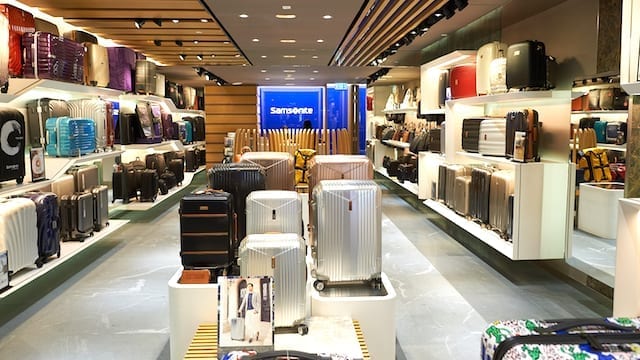
In the first half of the fiscal year 2025, the globally renowned luggage behemoth, Samsonite Group, saw a decrease in net sales and profits. This decline was attributed to a reduced demand for travel within their most significant markets.
The firm announced an adjusted net income of US$123.4 million, reflecting a drop of 29.1 per cent from the corresponding period the previous year. Net sales for the period ending 30th June saw a decrease of 6 per cent year-over-year, amounting to US$1.66 billion on a constant currency basis. The decrease was most prominent in the Asian and North American markets.
The CEO of Samsonite Group, Kyle Gendreau, commented on the situation. He expressed the belief that while consumers continue to value travel and experiences, there was a noticeable drop in travel demand in the first half of 2025. Gendreau attributed this to factors such as macroeconomic uncertainties, changing trade policies, and weakening consumer sentiment. He also forecasted that these trends would likely persist in the second half of the year, negatively impacting the short-term demand. Despite this, he maintained confidence in the long-term demand for travel aiding the business.
The company’s flagship brand, Samsonite, saw a sales drop of 4.7 per cent. Even though there was robust growth in Europe (+0.6 per cent) and Latin America (+0.2 per cent), there was a visible weakness in Asia (-8.8 per cent) and North America (-5.7 per cent).
In contrast, the Group’s premium brand, Tumi, demonstrated resilience with a minor sales decrease of 2.5 per cent overall. This was propelled by strong double-digit growth in Latin America (+18.6 per cent) and Europe (+6.2 per cent). However, it also witnessed sales decline in North America (-4.7 per cent) and Asia (-2.5 per cent).
The value-oriented American Tourister brand encountered a sharper sales decline of 12.7 per cent, especially in North America and Asia. This happened despite a moderate increase in Europe.
Even with the downward trend, the company noted a steady performance in non-travel categories such as backpacks and accessories, which experienced a modest growth of 0.1 per cent. These sectors made up 36.2 per cent of total sales, led by a significant 14.7 per cent increase in Gregory.
In a bid for market expansion, Samsonite opened 21 new company-operated retail stores in the first half of the year, and continued to invest in product innovation.
In conclusion, Samsonite Group continues to concentrate on brand elevation and geographical growth, while also considering a potential US listing, dependent on market conditions.
What are the main factors contributing to Samsonite Group’s sales decline?
The primary factors are macroeconomic uncertainties, shifting trade policies, and weakening consumer sentiment.
How has their premium brand, Tumi, performed in comparison to the flagship Samsonite brand?
Tumi has shown resilience with a smaller overall sales decline, driven by strong growth in Latin America and Europe.
How have non-travel categories performed?
Non-travel categories such as backpacks and accessories have shown steady performance, with a slight growth of 0.1 per cent, accounting for 36.2 per cent of total sales.