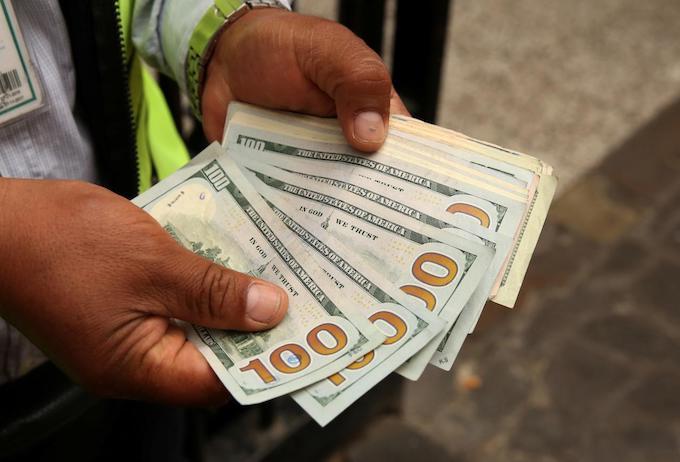
The U.S. dollar held steady against the Vietnamese dong on Wednesday, even as it experienced a slight decline against several major world currencies. At Vietcombank, the dollar remained unchanged at VND26,140, while the black market valued it at VND26,500. The State Bank of Vietnam also kept its reference rate stable at VND24,973.
Globally, the dollar found some stability following its most significant drop in over three weeks. This came in the wake of lower-than-anticipated U.S. consumer inflation data, which tilted the scales toward a potential easing by the Federal Reserve, especially as global trade tensions seem to be calming. Reports suggest, however, that this stability may be short-lived, as the U.S. dollar index, which evaluates the currency against six major peers, dipped 0.1% to 100.87 after a 0.8% decline the previous day.
Earlier in the week, the index surged 1% and reached a one-month high, bolstered by optimism surrounding a de-escalation in U.S.-China trade tensions, which many believed could stave off a looming global recession. Nevertheless, analysts at TD Securities predict a 5% decline in the dollar during the second half of the year as investors consider diversifying away from U.S. assets amidst rising uncertainty and volatility surrounding U.S. policies.
In offshore trading, the dollar appreciated by 0.24% to 7.2122 yuan, recovering slightly after falling to a six-month low of 7.1791 yuan on the prior day. However, it took a hit against the yen, declining 0.41% to 146.89, extending Tuesday’s drop of 0.66%. The dollar also slipped 0.1% to 0.8384 Swiss francs, while the euro and sterling remained largely unchanged at $1.1191 and $1.3307, respectively.
This financial juggling act is quite a spectacle—it’s almost like watching a game of currency twister!
Why did the U.S. dollar remain stable against the Vietnamese dong?
The U.S. dollar held steady as Vietcombank and the black market showed little fluctuation, with the dollar consistently valued around VND26,140 and VND26,500, respectively.
What factors influenced the global dollar’s recent performance?
A combination of lower-than-expected U.S. consumer inflation data and easing global trade tensions contributed to the dollar’s slight decline against major currencies.
What do analysts predict for the dollar’s future?
Analysts at TD Securities foresee a potential 5% drop in the dollar in the latter part of the year as global investors look to diversify their portfolios amid ongoing uncertainty and policy volatility in the U.S.