
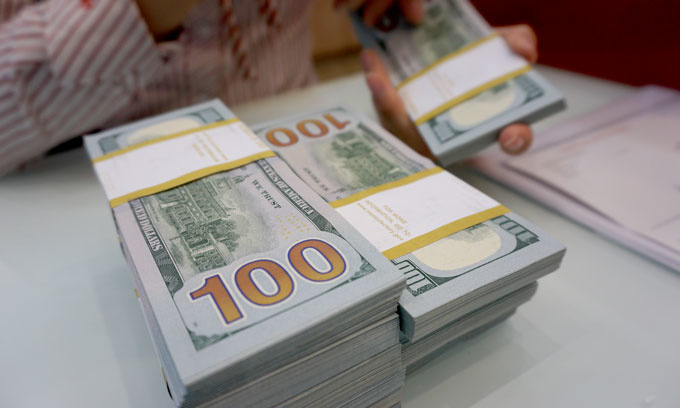
The US dollar experienced a minor decrease against the Vietnamese dong in the informal market this past Saturday. The devaluation, at a modest 0.08%, saw the dollar trading at VND 26,250 at unauthorized exchange locations.
Vietcombank, a significant player in the Vietnamese financial landscape, held its rate steady for the fourth consecutive day, maintaining a rate of VND 26,160.
On the global stage, the US dollar remained largely unchanged against its counterparts on Friday. This stability follows an unexpected below-forecast rise in inflation for January, implying the US Federal Reserve may maintain its current rates for the near future.
The Japanese yen, on the other hand, is on track for its most significant weekly increase in nearly 15 months.
Statistics released by the US Labor department on Friday revealed a 0.2% increase in the consumer price index for the previous month. This is slightly lower than the 0.3% predicted by economists.
The euro saw a small rise of 0.02% against the dollar, reaching a rate of $1.1873. If current trends continue, the euro is set to gain 0.5% this week.
In comparison, the US dollar saw a dip of 0.22% against the Swiss franc, falling to 0.76785. If this tendency holds, it would equate to a weekly loss of 1% for the dollar.
Analysts at Goldman Sachs, including Alexandra Kanter, attribute the relative weakness of the US dollar to several factors. These include the unpredictable nature of US policymaking in January, a recent reduction in market outperformance due to a sell-off in the software sector, and unique developments in Asia. Of particular note is the ongoing strengthening of the Chinese yuan.
What was the exchange rate between the US dollar and the Vietnamese dong on the black market this Saturday?
The US dollar traded at VND 26,250 against the Vietnamese dong in the black market.
What effect did the lower-than-expected inflation rise have on the Federal Reserve’s decisions?
The less than expected increase in inflation suggests the Federal Reserve may continue to hold its rates steady in the near term.
Which factors are contributing to the relative weakness of the US dollar?
The relative weakness of the US dollar is attributed to unpredictable US policymaking in January, a recent reduction in equity market outperformance due to a software sector sell-off, and unique developments in Asia such as the strengthening Chinese yuan.