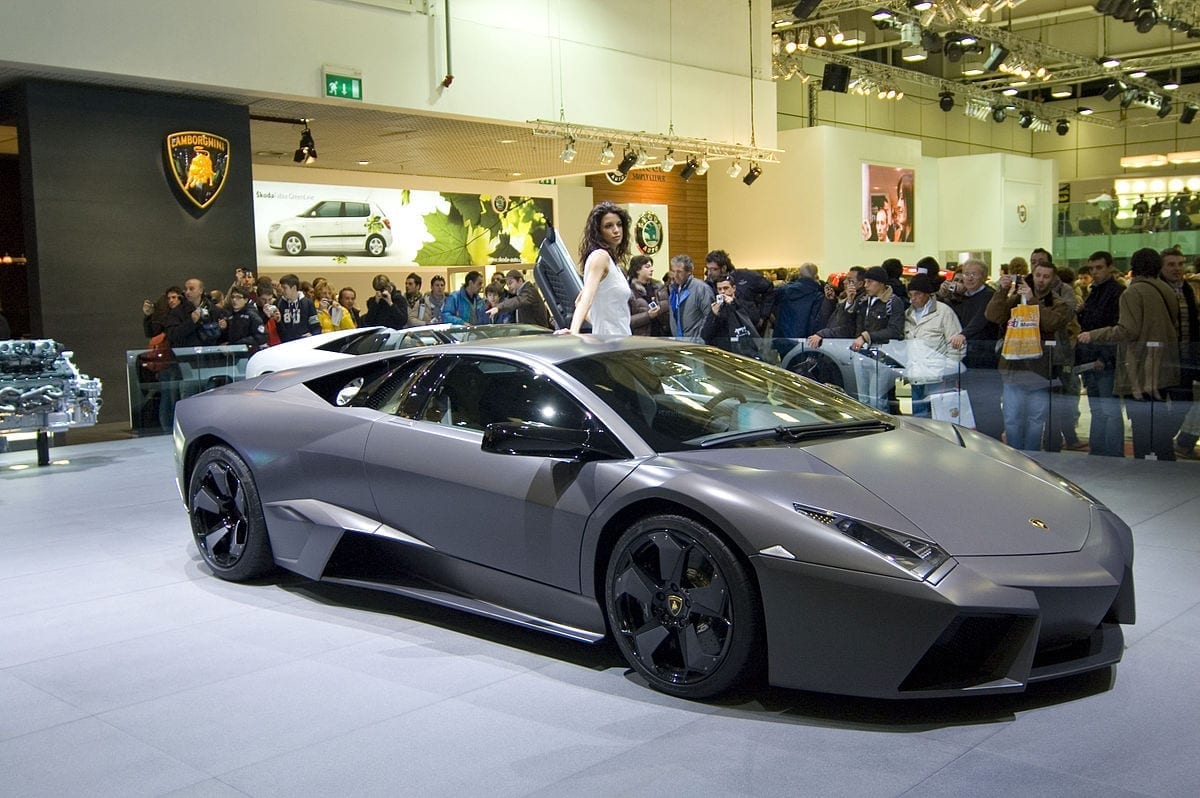
You get the sense that it’s a slightly bizarre experience for Lamborghini also; the concept, called Asterion, doesn’t have the reckless swagger we’ve come to expect of Lamborghini. This, says the company’s suave CEO Stephan Winkelmann, is deliberate; the Asterion is not designed to chase, thrills, lap times and the tails of the LaFerrari and the 918. Instead its ibrido powertrain is programmed to deliver a less visceral experience than the V12 Aventador and V10 Huracan. It is, says Winkelman, more of a GT.
Filippo Perini, head of design at Lamborghini, last year completed a full cycle of new cars with the Huracan, which replaced the Gallardo designed by his predecessor Luc Donckerwolke (now at VW Group’s Bentley label).
The 2011 Aventador now looks in retrospect the high water mark for Lamborghini’s intensely geometric phase; the Huracan is visibly softer and the Asterion softer still. It still has the ability to shock, mind you. In profile it appears to carry a lot of weight between the cabin and the rear wheels, as the 1976 Silhouette did (there are shades of another ‘70s supercar in there also; the De Tomaso Pantera) Is this Perini getting hip to the ‘70s supercar revival or is he trying to tell us there is something different going on in there?
The powertrain uses the Huracan’s 5.2-litre V10, here rated at just over 600bhp. However the Asterion has no less than three electric motors, one for each front wheel and another between the V10 and the seven-speed transmission. Together they can add nearly 300bhp more to the output, taking it close to 900bhp maximum and, of course, four wheel drive. The electrical power is stored in a lithium ion battery pack that sits along the spine of the car, where the mechanical drive for the front wheels would normally be. Engineering wise the Asterion is based on the carbon fibre and aluminium structure of the Huracan; philosophically the hybrid layout is borrowed from yet another VW label, Porsche.
Lamborghini is running something of a deficit when it comes to turning concepts into reality. The Estoque four-door was shown in Paris six years ago now and is presumed dead. The Urus SUV (first shown in China two years ago) has been confirmed for production, although no date has yet been given. The Asterion’s rear-heavy profile has an echo of the Urus concept and you wouldn’t want to bet against the SUV using some kind of ibrido powertrain; the longer the wait, the more dated the idea of an old-school Lamborghini SUV seems.