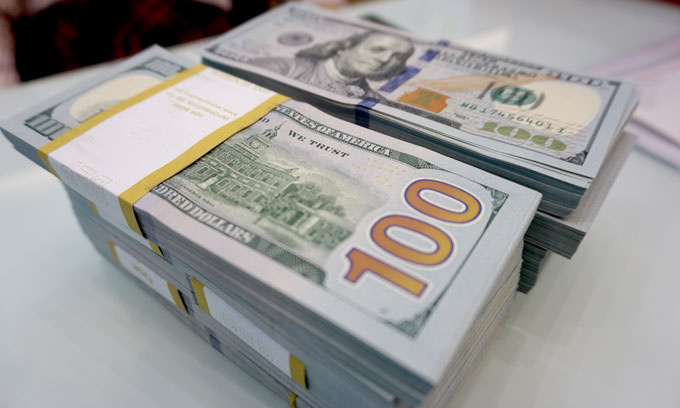
On a recent Friday morning, the U.S. dollar experienced a minor depreciation against the Vietnamese dong, continuing its trend near a five-week low against major global currencies. Vietcombank, one of Vietnam’s most significant financial institutions, recorded the greenback’s trading value at VND26,408, marking a marginal decline of 0.004% from the previous day’s closing. Concurrently, the black market saw the U.S. dollar’s value slide by 0.05% to approximately VND27,402.
Reflecting global trends, the State Bank of Vietnam adjusted its reference rate down by 0.004% to VND25,151. Globally, the U.S. dollar has been trading near a five-week low against its principal counterparts, contributing to expectations of a rate cut by the Federal Reserve in the following week.
The dollar index, which gauges the U.S. currency against a basket of six significant rivals, remained static at 99.065 in the early Asian market hours. Earlier, it had dropped to a five-week low of 98.765, maintaining its trajectory for a 0.4% drop over the week.
Against the yen and the euro, the dollar’s performance was relatively unchanged at 155.18 yen and $1.1647 respectively. The British pound remained robust at $1.3326, despite retreating from a six-week high in the prior trading session.
The Australian dollar stayed consistent at $0.6609, following its surge to a two-month peak of $0.6624 the previous day. The Canadian dollar, or loonie, mirrored this stability, registering little change at C$1.3961 per U.S. dollar. Meanwhile, the Swiss franc remained steady at 0.8035 per dollar, despite recoiling sharply from Wednesday’s high of 0.7992 in the overnight session.
The U.S. dollar has faced additional devaluation pressure in recent times due to speculation regarding changes in the Federal Reserve’s leadership. Market participants are contemplating the implications of Kevin Hassett, the White House economic adviser, potentially succeeding Jerome Powell as the Federal Reserve Chair following the conclusion of Powell’s term in May. Hassett’s anticipated advocacy for further rate cuts is contributing to these market dynamics.
Why is the U.S. dollar weakening against the Vietnamese dong?
The dollar’s depreciation can be attributed to global financial trends and expectations of a forthcoming rate cut by the Federal Reserve.
What impact does the Federal Reserve chair’s potential succession have on the dollar?
The potential appointment of Kevin Hassett, known for advocating further rate cuts, as the Federal Reserve chair has escalated speculation and heightened pressure on the U.S. dollar.
How did other major currencies perform against the dollar?
The dollar’s performance was relatively stable against the yen, euro, pound, Australian dollar, Canadian dollar, and Swiss franc.