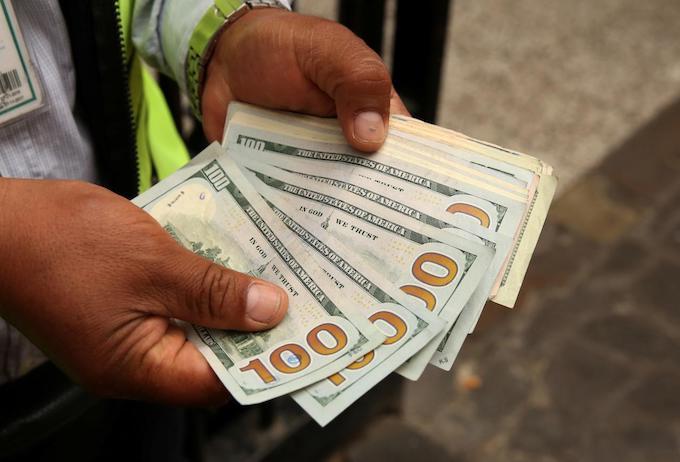
The U.S. dollar has taken a notable leap against the Vietnamese dong, maintaining its stability against major currencies as of Thursday morning.
At Vietcombank, the greenback was sold at VND26,276, reflecting a 0.13% increase. Meanwhile, the State Bank of Vietnam raised its reference rate by 0.12%, bringing it to VND25,025. In the informal market, the dollar climbed even higher, hitting VND26,410—a 0.34% rise.
Internationally, the dollar has held its ground amid cautious sentiments arising from Federal Reserve Chair Jerome Powell’s recent remarks on inflation. Investors are also keeping a watchful eye on escalating geopolitical tensions in the Middle East, adding to the market’s precariousness, as reported by Reuters.
As for the euro, it traded at $1.14805, indicating a 0.6% drop this week—the largest decline since early May. The Japanese yen made a slight recovery, sitting at 144.86 per dollar, while the Swiss franc was valued at 0.81895 per dollar.
Amid all this, the dollar index, gauging the currency against a basket of six others, stood at 98.957. This positions it for a 0.8% weekly gain, marking the most robust performance since late February. In the world of currency exchange, it seems the greenback is strutting its stuff like a confident runway model.
Why did the U.S. dollar rise against the Vietnamese dong?
The dollar’s increase against the dong can be attributed to the State Bank of Vietnam raising its reference rate, combined with overall strong performance in the global market.
What does the rise in the dollar index signify?
A rising dollar index indicates that the U.S. dollar is performing well against a range of other currencies, suggesting increased investor confidence in the dollar.
What factors are influencing the currency market currently?
Investor sentiments are influenced by Federal Reserve commentary on inflation, along with ongoing geopolitical tensions in the Middle East, creating a cautious global financial atmosphere.